
This post touches on a health topic. Please read it closely.
People with arthritis usually get two pieces of advice that seem to cancel each other out: protect your joints, and stay active. Most of them settle somewhere in the middle by doing less. The research points the other way.
Arthritis is common enough that almost everyone over 45 knows someone dealing with it. In 2023 the CDC reported that 53.2 million US adults have doctor-diagnosed arthritis, and almost 9 in 10 of them are 45 or older.
This post is the big-picture guide: what the major guidelines recommend, why strength matters for sore joints, and how coached training works around a joint that has good days and bad ones. If your main question is about sore knees specifically, our post on strength training with achy knees goes deeper there.
Arthritis is common, and it isn't one condition
"Arthritis" covers more than one diagnosis. Osteoarthritis, which affects the cartilage in joints like the knees, hips, and hands, is the type most exercise research focuses on, and it's the focus of this post. Inflammatory types such as rheumatoid arthritis are managed differently, and your rheumatologist sets the boundaries there.
You see arthritis in ordinary Fairfax life. It's the golfer at Army Navy Country Club on Blenheim Boulevard whose hip complains by the back nine. It's the tennis player at Van Dyck Park who quietly stopped signing up for doubles. It's the person who spent last month's Fall Festival in Old Town looking for benches instead of walking the vendor rows. The usual response is to move less, and the muscles around the sore joint weaken too.
What do the guidelines actually recommend?
The clearest answer comes from the people who write the treatment rules. The 2019 American College of Rheumatology and Arthritis Foundation guideline for hand, hip, and knee osteoarthritis strongly recommends exercise, including strengthening, aerobic, neuromuscular, and water-based exercise.
Exercise was the only non-drug treatment to earn a strong recommendation for all three joints. It isn't a backup plan. It's a core part of care.
The newer version holds the same line. Reporting on the 2026 ACR update notes that exercise remains a strong recommendation for knee and hip osteoarthritis, with more emphasis on shared decisions and individualized treatment.
That last part matters. "Individualized" means your plan should fit your joints, your history, and what your doctor has told you. If you've been diagnosed with arthritis, talk with your doctor or physical therapist before you start, and bring what they tell you to your coach.
Why strength work matters for sore joints
Muscles are the shock absorbers and steering system around a joint. Strong quads and glutes help control how load moves through a knee or hip with every step, every stair, and every time you get out of a car. When those muscles weaken, the joint itself has less support.
That's why a guideline built around pain and function puts strengthening on the list. The goal is to make everyday loads (a flight of stairs, a bag of mulch, a grandchild) a smaller share of what your body can handle.
Range of motion matters too. Training through a comfortable range, and slowly expanding it, keeps the joint used to moving.
How a coach modifies training around arthritis
Good coaching for arthritis starts before the first set. A functional movement assessment identifies mobility restrictions, muscle imbalances, and movement limitations before training begins, so your coach knows which joints need care and which can be pushed.
From there, most of the work is about choosing the right version of each movement:
- Squats become box squats to a height that stays comfortable, or goblet squats with a short range that grows over time.
- Lunges that bother a knee can give way to sled pushes or low step-ups.
- Carries like the farmer carry build grip, posture, and leg strength without deep joint angles.
- Tempo slows down, so the muscle does the work and the joint isn't jolted.
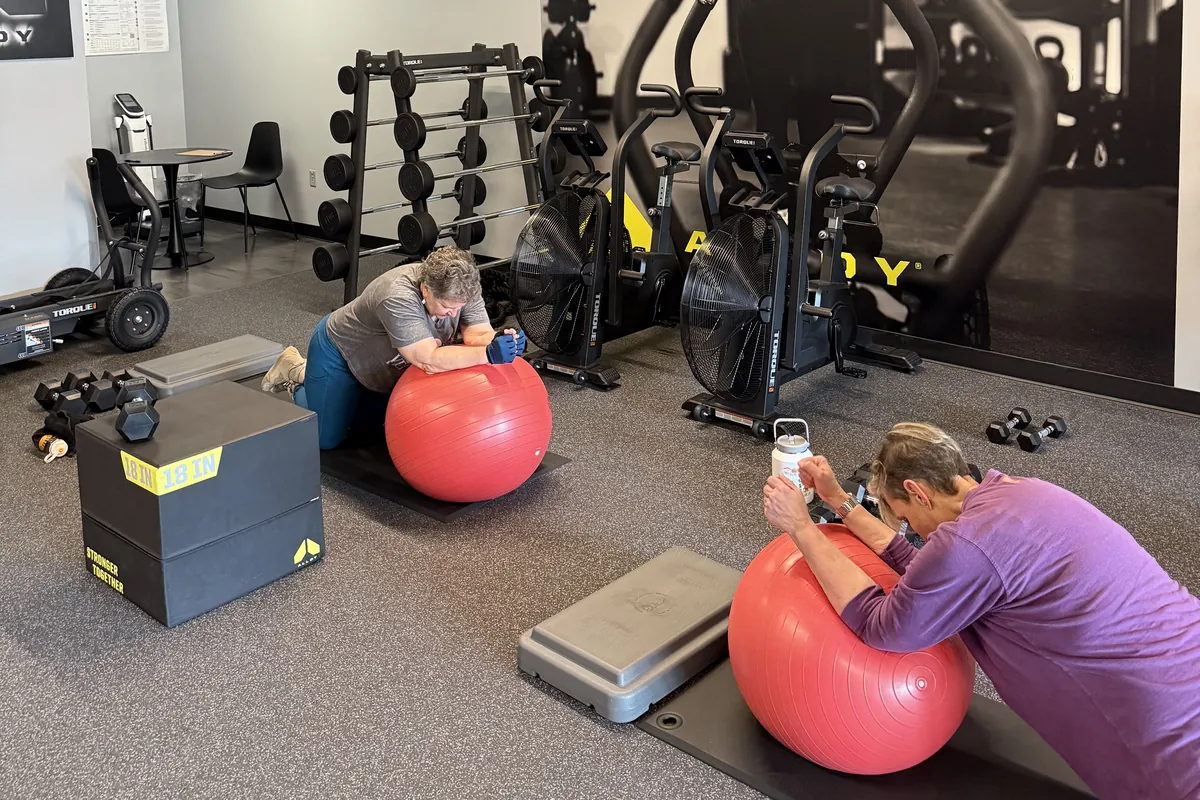
In small group personal training, sessions are capped at six members and individualized to each person's fitness level, mobility, injuries, and goals. Someone with a cranky hip and someone with no joint issues can train side by side on different versions of the same plan.
What happens on a flare day?
Arthritis has rhythms. A cold November morning, a long day on your feet, or no obvious reason at all can make a joint flare. The worst response is usually to disappear for three weeks.
The better approach is to tell your coach when you walk in. A flare day doesn't have to be a lost day. Your coach can lower the load, shorten the range, swap the exercise that hits the sore joint, and shift the session's focus to the parts of your body that feel fine.
Some days the right call is rest, and that's fine too. Your doctor's or physical therapist's guidance on how much discomfort is acceptable comes first. A coach's job is to work inside those limits, not around them.
Longer goals help on the harder weeks. Walking the full 4.7-mile loop at Burke Lake Park or finishing 18 holes on foot are concrete targets to train toward, even with detours.
What should your first step be?
If you have arthritis and want to start strength training, the first visit should be about information, not intensity. The Complimentary Intro Session starts with a one-on-one conversation with a coach about your goals, health history, and training experience, which is the moment to share your diagnosis and anything your clinician has told you. It also includes a functional movement assessment, an InBody body composition analysis, and an introductory workout scaled to you. No pressure, no obligation.
The studio is on Main St near Old Town Fairfax, and members come from the City of Fairfax and nearby Fairfax Station, Burke, Vienna, Oakton, and Mantua.
Book Your Complimentary Intro Session.