
Ask adults over 40 why they do not strength train and knees come up more than any other body part. It makes intuitive sense: the knees already complain on stairs, so loading them with weights sounds like volunteering for trouble.
The intuition has it backwards, and this is one of the most useful reversals in all of fitness: for ordinary achy knees, appropriate strength training is not the threat. It is the treatment the joint has been waiting for. The muscles around your knee are its suspension system, and suspension systems are exactly what the untrained years quietly dismantle. Here is how training with cranky knees actually works.
First, the boundary
Achy is a broad word, so the sorting matters. Knees that are swollen, unstable, locking, or the site of a recent injury, or pain that is sharp rather than grumbling, belong to a physician or physical therapist first, full stop. The same goes for diagnosed conditions: get the professional assessment, then bring us the guidance, and we will build inside it, which is routine work in our sessions. What follows is about the everyday version: knees that grumble on stairs, stiffen in the morning, and have opinions about kneeling, with no red flags attached.
Why does strengthening help an achy knee?
Because most everyday knee grumbling is, at root, a support problem. The quadriceps, hamstrings, and hip muscles absorb force, control alignment, and share the load every time you step, squat, or descend a staircase. When those muscles weaken, the joint itself absorbs more of every step, and it files complaints. Research on knee osteoarthritis and general knee pain keeps landing in the same place: appropriate strengthening of the muscles around the knee and hip is among the most consistently effective things people can do, improving both pain and function for many. Rest, the intuitive prescription, tends to make the support problem worse; the muscles shrink further while the complaint continues.
What does knee-friendly programming look like?
The craft is in loading the muscles without provoking the joint, then expanding what the joint tolerates as support returns:
- Range you own today. Squatting to a higher box, hinging instead of deep bending, shortening a lunge: same muscles, friendlier arcs, progressed deeper as comfort grows.
- Hips do heavy lifting. Glute and hamstring work, hinges, bridges, and their cousins, builds the support system above the knee, which changes what the knee experiences below.
- Controlled tempo. Slow, owned lowering builds exactly the braking strength stairs and descents demand, in doses the joint accepts.
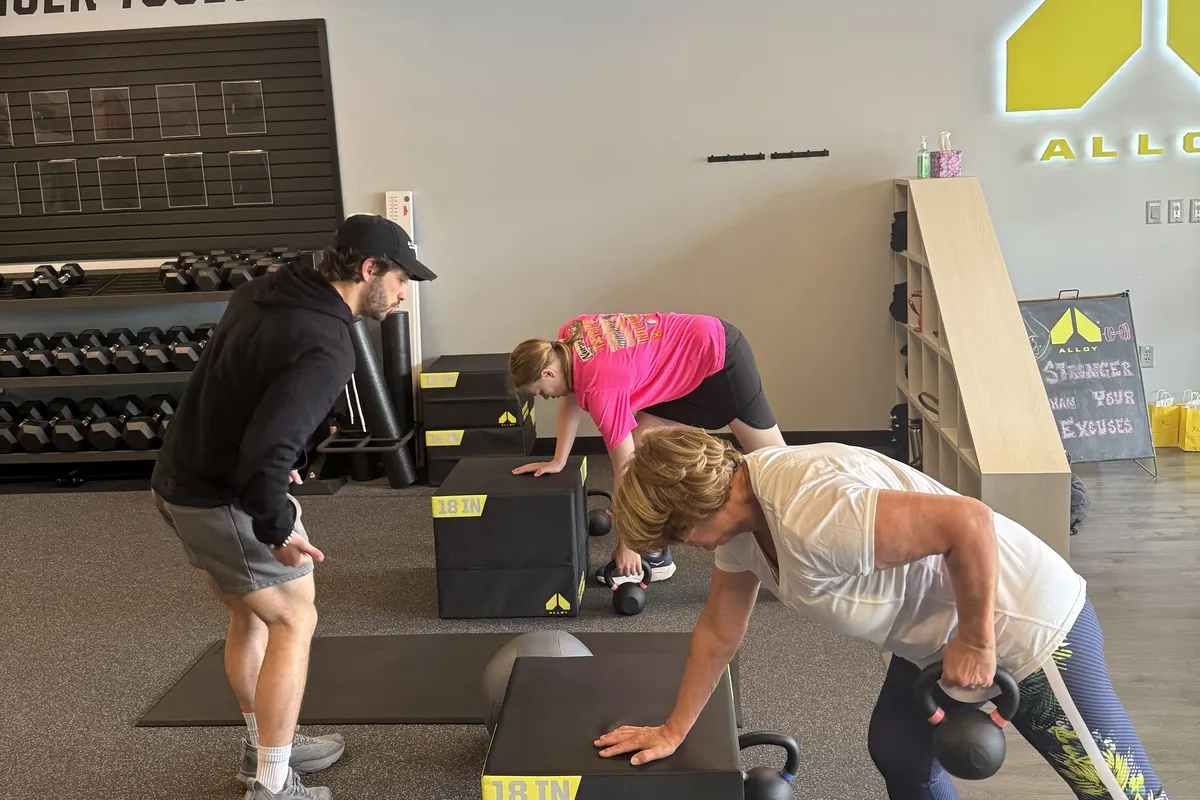
- Modification in real time. Something grumbles today, the exercise changes today: different range, different variation, same training effect. This is precisely what a coach watching six or fewer members is for, and why big-box guesswork fails knees so reliably.
- Progression measured in months. Knees that took years to get cranky extend surprising goodwill within weeks, but the durable change compounds over a season.
What tends to happen when people do this?
A familiar arc: the first weeks feel cautiously fine, which is itself news to someone who expected training to hurt. Then stairs start costing less. Then, a few months in, the knee stops being a daily character in their life's narration, which members mention with the specific relief of people who assumed the grumbling was permanent. Strength numbers, meanwhile, climb the ordinary way, because none of this required training less seriously, only training more intelligently. The knee did not need protecting from strength. It needed the strength.
Start where your knees actually are
Every program here begins with a Complimentary Intro Session at our Fairfax City studio: your full history, knees included and taken seriously, an InBody body composition scan, a functional movement assessment where we watch how you actually move, and a coached introductory workout scaled to what today's body tolerates. From there, sessions capped at six members mean your modifications happen automatically, every visit, while the support system rebuilds.
If you are in Fairfax City, Mantua, Burke, Fairfax Station, or Vienna, and your knees have been the reason you have not started, book your Complimentary Intro Session. Bring the knees. They are more trainable than they have led you to believe.