
This post touches on a health topic. Please read it closely.
A bone density report can land like a verdict. One month you're walking the loop at Burke Lake Park without a second thought, and the next you're reading the word "osteoporosis" next to your name and wondering if you should lift anything heavier than a laundry basket.
It's a common moment. Among US adults 50 and over, 19.6 percent of women and 4.4 percent of men have osteoporosis at the hip or lower spine, and 43.1 percent have low bone mass, according to the CDC's National Center for Health Statistics.
Bone responds to load, and the research on strength training for bone is more encouraging than most people expect. The catch is in how that training is done.
Why bone loss matters more than the number on the report
The real concern isn't the score itself. It's fractures. The Bone Health & Osteoporosis Foundation estimates that about 10 million Americans have osteoporosis, another 44 million have low bone density, and one in two women and up to one in four men age 50 and older will break a bone due to osteoporosis.
A broken hip or wrist later in life is rarely just a cast and a few weeks off. It can change how confident you feel on the stairs on the way into a show at George Mason's Center for the Arts, or on the unpaved paths at Daniels Run Park.
What the research shows: the LIFTMOR trial
For years, the standard advice for low bone density leaned gentle: walk, avoid heavy lifting, be careful. The LIFTMOR trial tested a different approach.
Researchers enrolled 101 postmenopausal women with low bone mass and published the results in the Journal of Bone and Mineral Research in 2018. One group did eight months of twice-weekly, 30-minute sessions of high-intensity resistance and impact training. A control group did low-intensity exercise.
The differences were modest in size but clear in direction:
- Lower spine bone density rose about 2.9 percent in the high-intensity group and fell about 1.2 percent in the low-intensity group.
- At the femoral neck (the top of the thigh bone, near the hip), the high-intensity group gained about 0.3 percent while the low-intensity group lost about 1.9 percent.
In other words, the gentle group kept losing bone, while the group that trained with real load held steady or gained.
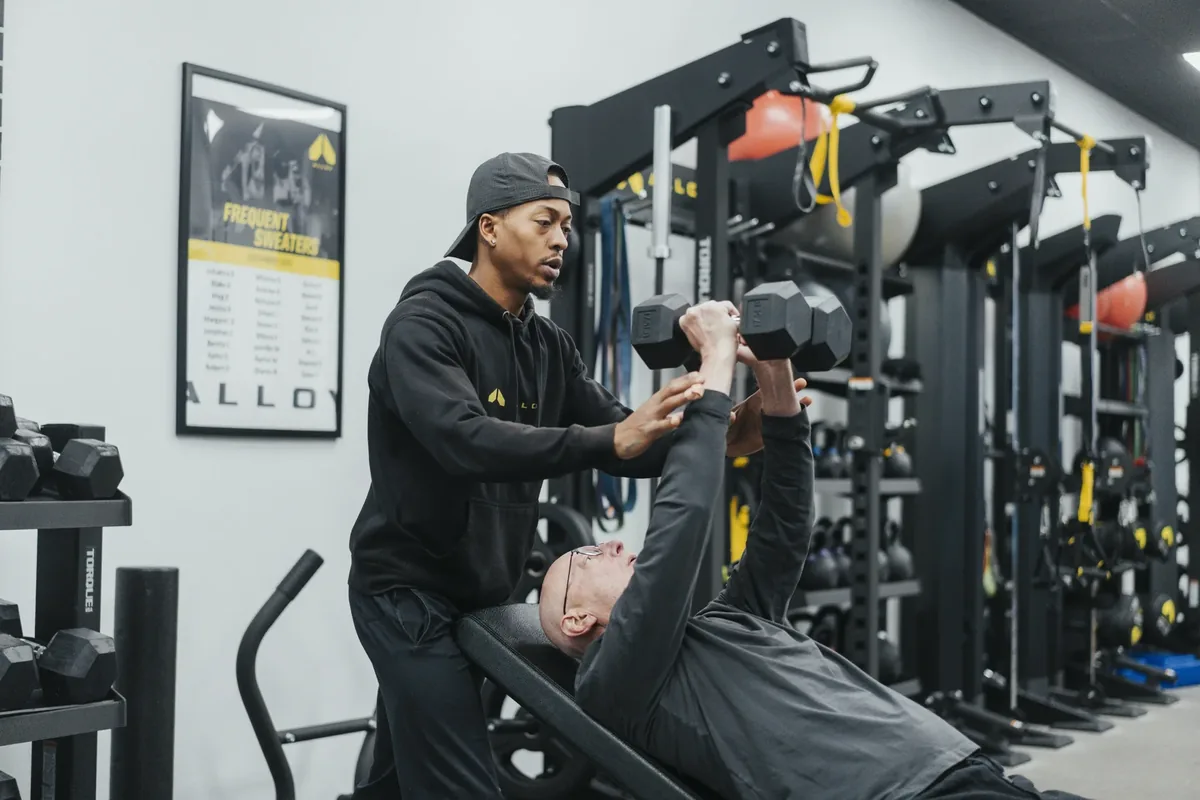
One word in the study design deserves more attention than it usually gets: supervised. These women weren't lifting heavy alone with a video for guidance.
A single trial can't predict what happens for any one person, but it makes a strong case that heavier, well-coached training belongs in the conversation.
What bone-friendly strength training looks like
Effective training for bone isn't exotic. It's the basic movement patterns, done with good form and loaded progressively over months. In a coached session, that might include:
- Goblet squats or box squats to load the hips and spine in an upright position
- Deadlifts or hip hinges from a raised height, so the back stays neutral
- Farmer carries, which load the whole skeleton while you walk
- Step-ups and sled pushes for leg strength that carries over to stairs and hills
- Gradual, carefully chosen impact work, only when it's appropriate for you
The starting weight is usually lighter than people expect. The point is to earn heavier loads with clean reps, not to test a max on day one.
Why coaching matters when bone density is low
Osteoporosis changes the risk math on technique. Rounding your back under load is the kind of position a doctor or physical therapist may want you to avoid, and it's easy to drift into when you're tired and nobody is watching.
If you've been diagnosed with osteoporosis or osteopenia, talk with your doctor or physical therapist before you start, and bring their guidance to your first session. A good coach works inside those limits, not around them.
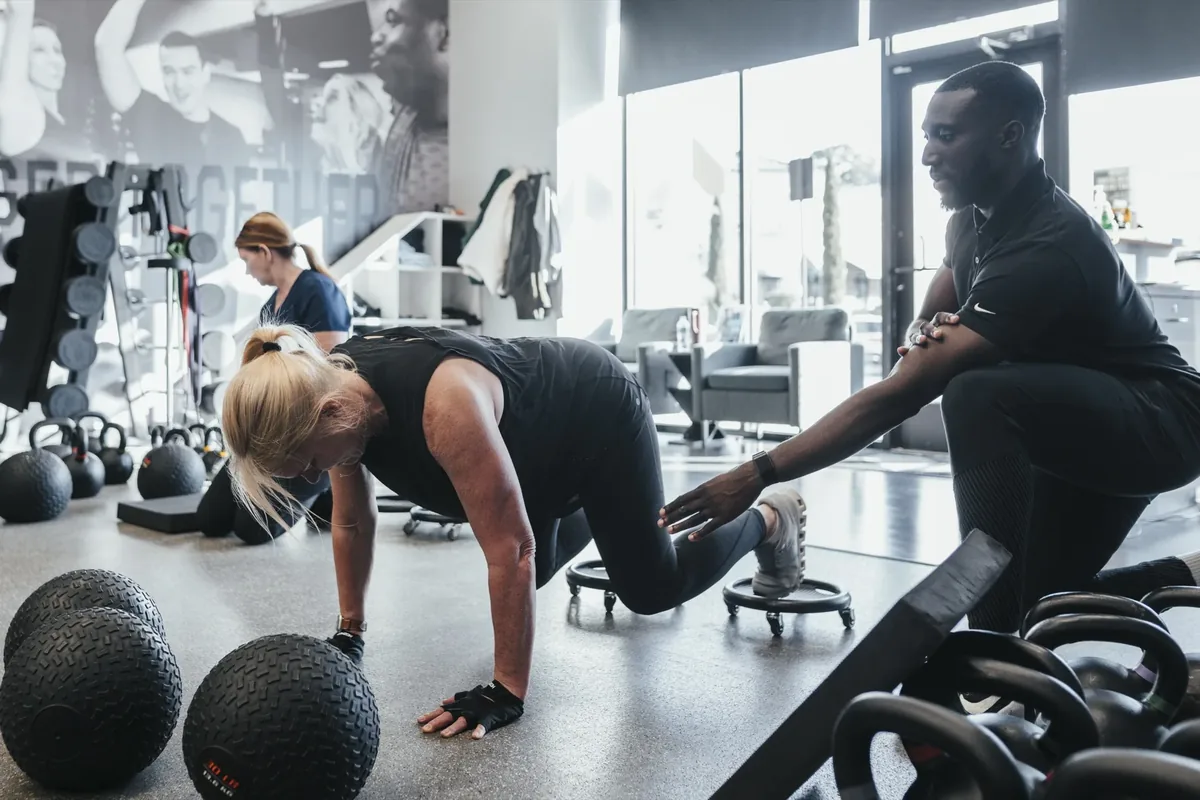
This is where the supervised part of LIFTMOR becomes practical. At Alloy, training starts with a functional movement assessment that looks for mobility restrictions, muscle imbalances, and movement limitations before any weight goes on the bar. Sessions are capped at six members, so a professional coach can see every rep.
For women in particular, women's personal training offers the same coach-led format in a group of six or fewer. If you're also navigating menopause, our post on strength training through menopause covers the wider picture.
Bone changes slowly, so consistency carries the load
LIFTMOR ran for eight months, twice a week. Bone doesn't change in a few weeks, and the benefit depends on showing up long after the novelty wears off.
That's harder in November and December, when the sun sets early and the holiday calendar fills. Two steady sessions a week beat an ambitious plan that collapses by mid-December.
Keep walking, too. A loop through Van Dyck Park or around Old Town Square on your off days is good for you. Just know the LIFTMOR results came from resistance and impact training, so the walk complements strength work rather than replacing it.
What should your first step be?
Start with a conversation, not a heavy barbell. The Complimentary Intro Session includes a one-on-one conversation with a coach about your goals, health history, and training experience, so your bone density results and your doctor's guidance are part of the plan from the start.
You'll also get a functional movement assessment, an InBody body composition analysis, and an introductory workout scaled to you. There's no pressure and no obligation.
The studio is on Main St near Old Town Fairfax, and members come from the City of Fairfax and nearby Fairfax Station, Burke, Vienna, Oakton, and Mantua. Book Your Complimentary Intro Session.