
This post touches on a health topic. Please read it closely.
Daylight saving time ended on November 1, and the sun now sets before 5 p.m. in Fairfax. First frost in the area typically lands between mid-October and mid-November, which means wet leaves on sidewalks, dark driveways, and slick front steps in the morning.
This is the time of year when a lot of people over 60 notice they're watching their feet more than they used to. A curb in the dark. The walk back to the car after an evening show at George Mason's Center for the Arts. A patch of leaves on a Main Street sidewalk. None of it used to take any thought.
That extra caution makes sense. It doesn't have to be permanent, though, and the research on what changes it is unusually clear.
Why falls deserve your attention after 60
Falls are the leading cause of injury for adults 65 and older, according to the CDC. More than 14 million older adults, about one in four, report falling each year. About 37 percent of those who fall report an injury that needed medical treatment or kept them from their usual activities for at least a day.
The fall itself is only part of the problem. After a scare, many people start moving less: they skip the walk, take the elevator, pass on the trip. Less movement means less strength and less practice balancing, which makes the next fall more likely. Breaking that loop is the whole point of training for it.
What the research says exercise can do
The best summary available is the 2019 Cochrane review led by Sherrington, covering 59 trials and nearly 13,000 community-dwelling adults 60 and over. Its findings:
- Across all exercise types, the fall rate dropped 23 percent, with the evidence rated high certainty.
- Balance and functional exercise on its own cut the rate by 24 percent.
- Programs combining multiple types of exercise, typically balance plus resistance training, reduced it by about 34 percent (moderate certainty).
Exercise also cut the number of people who fell at least once by about 15 percent.
The combined-program number is the one worth paying attention to. Balance drills help. Balance drills plus getting stronger appear to help more. No program guarantees results for any one person, but the direction is clear.
Why strength belongs in a balance program
Balance isn't only about standing still without wobbling. When you trip, what saves you is a quick step and a leg strong enough to catch your full body weight, usually on one foot and usually at an awkward angle. That's strength and speed, not just steadiness.
Your hips do much of the work. The muscles on the outside of the hip keep your pelvis level every time you stand on one leg, which is what every single step is. Your calves and ankles make the small corrections on uneven ground. Your trunk keeps you upright when you carry bags in from the car or a laundry basket down the stairs.
Think about what the Fall Festival in Old Town asked of you back on October 10: hours on your feet, crowds, and curbs. Or the 4.7-mile loop at Burke Lake Park, mostly flat but gravel the whole way. Those are balance tests too, and they're easier on strong legs.
Then there's getting up off the floor without grabbing furniture, a skill worth keeping and one you can train.
What coached balance work actually looks like
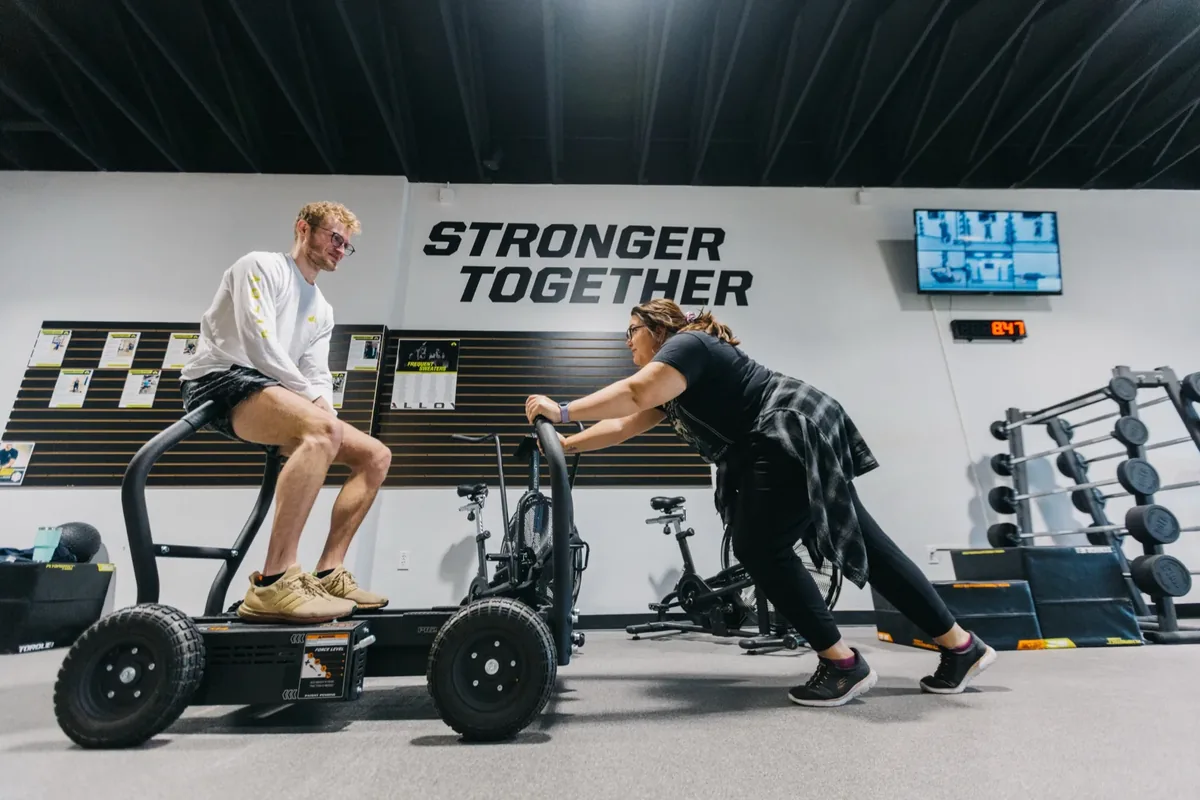
Balance training at Alloy isn't standing on a wobble board and hoping for the best. It's mostly familiar strength movements, chosen and scaled so you're challenged without being put at risk. A typical mix:
- Step-ups and split squats, which load one leg at a time
- Single-leg holds next to a rack or wall you can touch
- Farmer carries and suitcase carries (one weight in one hand), which teach your trunk to resist tipping
- Sled pushes, which build leg drive without a big balance demand
- Floor-to-standing practice, starting from bench height and working down
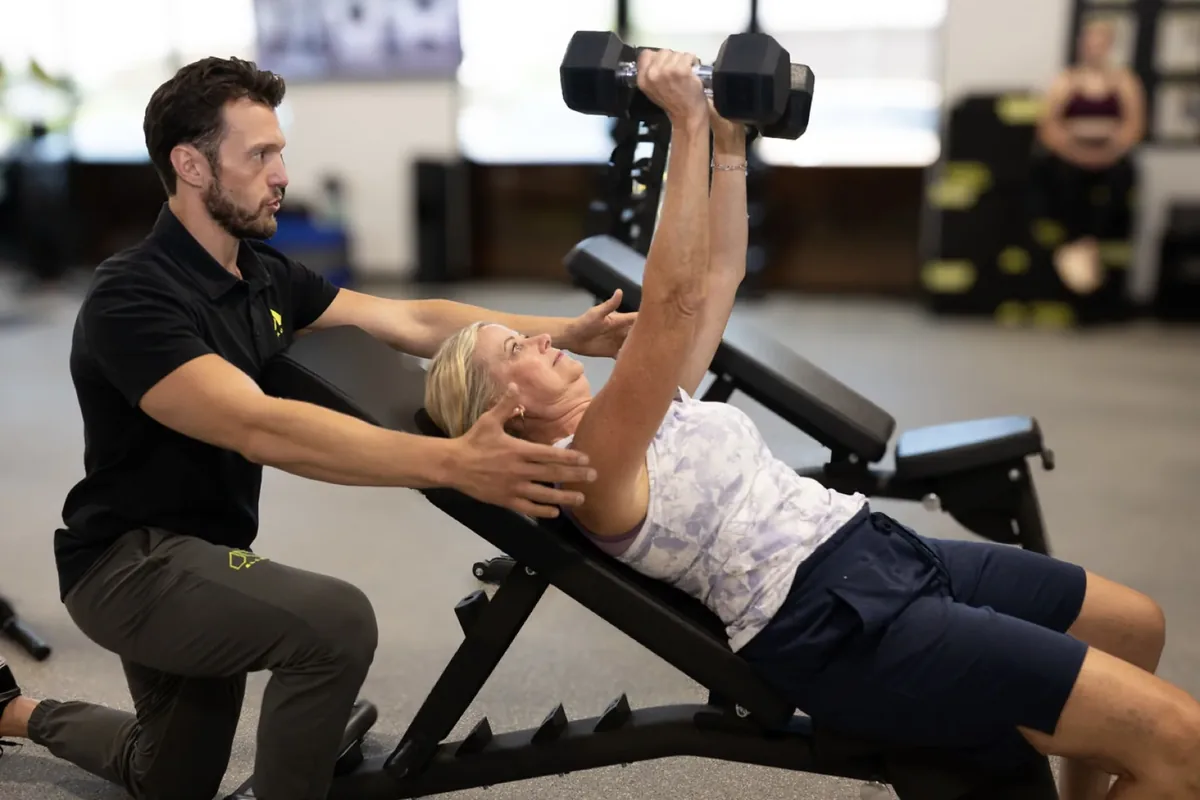
The progression is where coaching matters. A full hand on the rack, then fingertips, then nothing. Eyes straight ahead, then turning your head. Slow and controlled, then quicker. Sessions are capped at six members, so the coach can see when you're ready for the next step and when you're not.
Every member starts with a functional movement assessment that identifies mobility restrictions, muscle imbalances, and movement limitations before training begins. If one ankle barely bends or one hip is clearly weaker, the program accounts for it from day one.
If you've already fallen, get dizzy when you stand up, or have a condition that affects your balance, talk with your doctor or a physical therapist before you start, and keep them in the loop as you train. A coach works alongside that care, not in place of it.
For a broader look at training in your 60s and beyond, see our guide to personal training for seniors in Fairfax.
What should your first step be?
The Complimentary Intro Session is the on-ramp: a one-on-one conversation with a coach about your goals, health history, and training experience, plus a functional movement assessment, an InBody body composition analysis, and an introductory workout scaled to you. No pressure, no obligation.
Bring your real goal with you. It might be walking the Van Dyck Park trail without thinking about your footing, or standing comfortably through the Festival of Lights and Carols at Old Town Square on December 5. Members come from the City of Fairfax and nearby Fairfax Station, Burke, Vienna, Oakton, and Mantua, and the studio sits on Main St near Old Town Fairfax.
Book Your Complimentary Intro Session.