
There is a moment many adults hit somewhere past 65, often in a doctor's office, sometimes at the bottom of a staircase, when exercise stops being a should and becomes a plan. Maybe a physician said the words muscle mass out loud. Maybe a jar refused to open, or a curb got complicated. Whatever the trigger, the next question is practical: who should actually be coaching you at this age, and what should that coaching look like?
It is a better question than most fitness marketing deserves. Here is our honest answer, from a studio in Fairfax City where adults in their 60s, 70s, and beyond train every week.
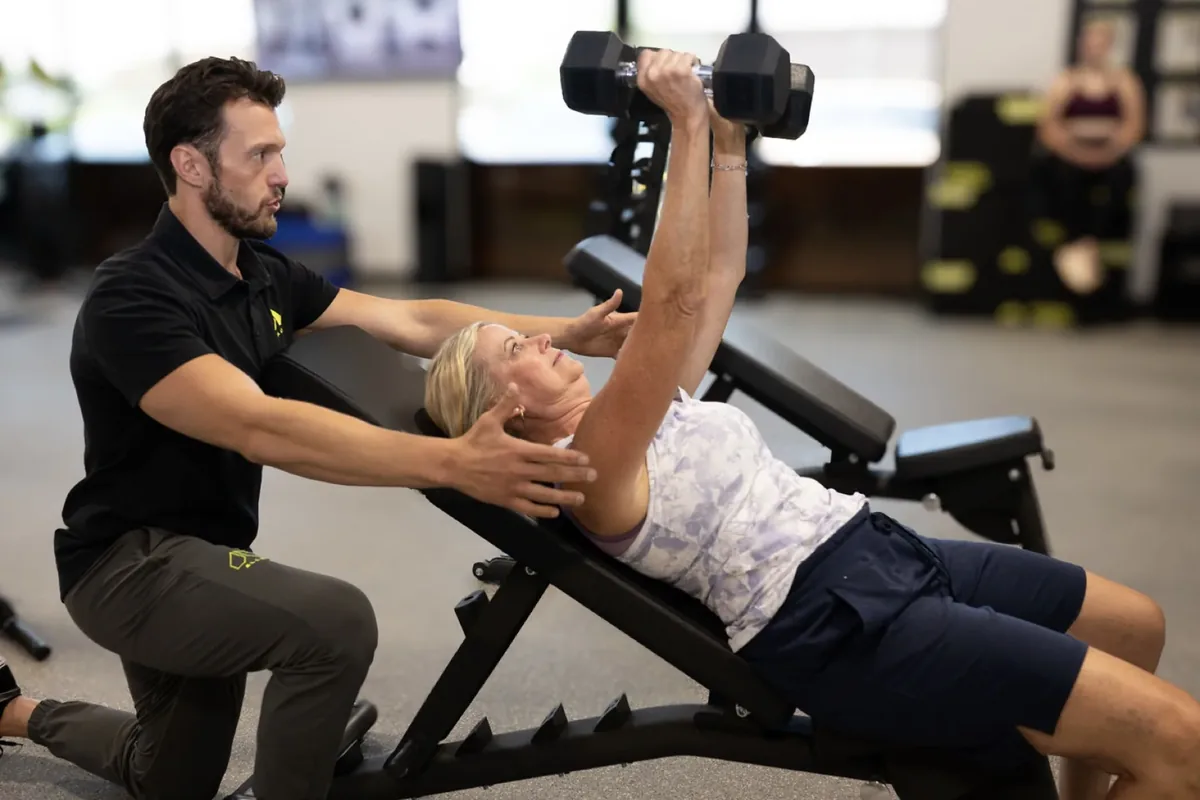
Why does personal training matter more after 65?
Because the margin for guessing shrinks while the payoff for training grows. On one side: joint history, medications, blood pressure, balance, decades of patterns, all of it real, none of it visible to a workout app or a wall of gym machines. On the other: research keeps showing that adults in their 60s, 70s, and 80s build meaningful strength with structured resistance training, and that the strength maps directly onto independence, steadiness, and how well the next decade goes.
High stakes plus high payoff is exactly the situation coaching exists for. The question is what kind.
What should senior-appropriate training actually include?
- A genuine assessment first. Health history, medications, movement, balance, goals, all before any workout happens. If a place starts you training without learning you, keep looking.
- Programming built for your body, not your birth year. Age alone tells a coach very little. Two 70-year-olds can be decades apart physically. Good programming starts from your actual assessment and progresses from there.
- Real progressive resistance. The gentle-forever approach quietly plans for decline. Muscles at every age keep what they are asked to use, so the weights should be honest for you and should grow over months.
- Balance and daily-life patterns woven in: sit-to-stands, carries, step-ups, floor get-ups. Training should rehearse the life you want to keep.
- A coach who watches every rep. Form is safety and results in one package. Ask any gym the golden question: how many people does my coach watch at once?
Is one-on-one training the only option?
No, and for many older adults it is not even the best one. One-on-one training delivers attention at a price that pushes most people to one session a week, which is below the frequency where strength actually builds. Large classes deliver frequency without attention. Small group personal training, the model our studio is built on, holds the middle deliberately: sessions capped at six members, a professional coach who knows every member's history, every exercise individualized, at a fraction of one-on-one cost, so training two to three times a week stays realistic. There is a social dividend too, and it is not minor: five other adults who notice when you are missing turn out to be excellent medicine for consistency, and consistency is the entire game. Our comparison of small group personal training covers the model in full.
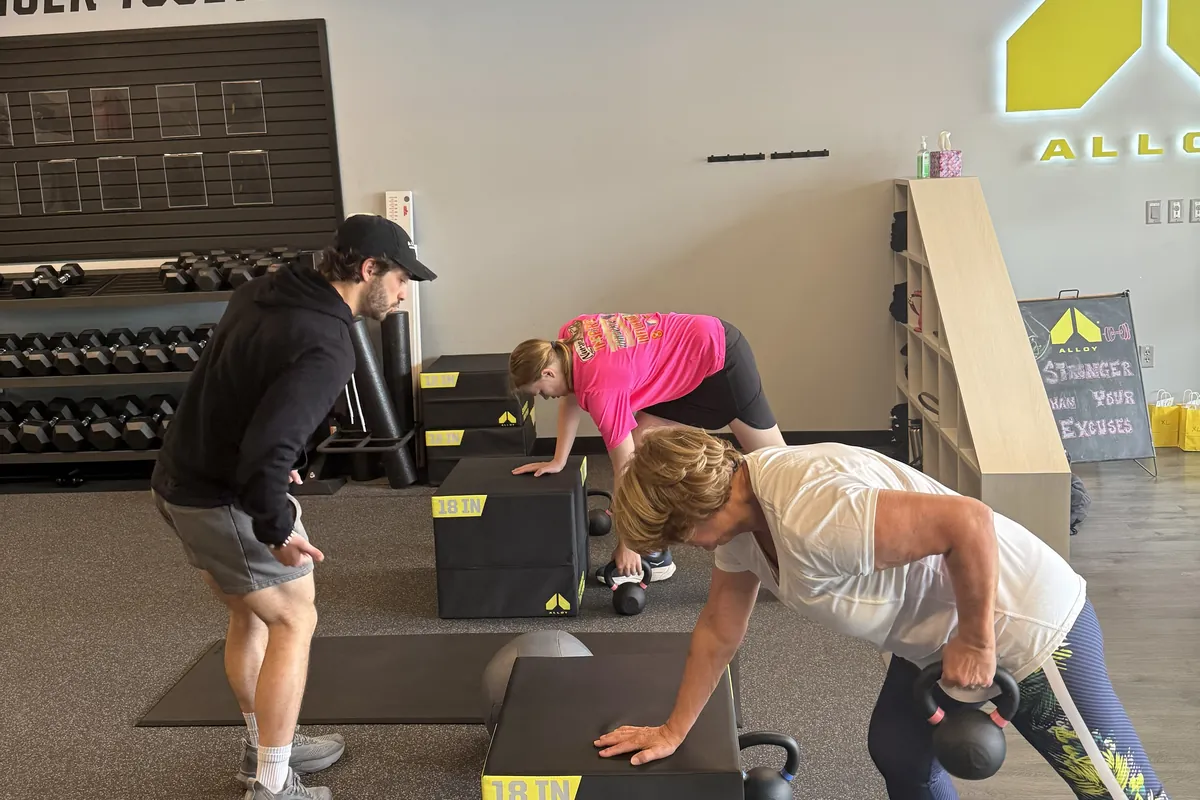
What results are realistic after 65?
Measurable and meaningful ones, on the standard timeline: strength gains within the first couple of months, easier daily tasks arriving in a reliable order, floors, stairs, groceries, luggage, and body composition trends visible on the monthly InBody scan that comes with membership here. Members in their 70s surprise themselves regularly. What nobody should promise is transformation-by-Thanksgiving; what the research and our training floor both support is steady, compounding change for as long as you keep showing up.
How do you start in Fairfax?
With a conversation instead of a commitment. Our studio in Fairfax City starts every prospective member, at every age, with a Complimentary Intro Session: your health history and goals, an InBody body composition scan, a functional movement assessment, and a coached introductory workout, ending with straightforward membership answers. Physician guidance is welcome material; bring it and we build around it.
If you are in Fairfax City or nearby, Mantua, Fairfax Station, Burke, or over toward Vienna, book your Complimentary Intro Session. The decade ahead is trainable. We would be glad to prove it to you.