
The 4.7-mile loop around Burke Lake is mostly flat, and it still finds the weak spots. Past the halfway mark, tired hips change your stride, your knees notice every loose patch of gravel, and the last mile feels longer than the first three.
That is less a cardio problem than a strength problem. Walking builds endurance, but it rarely asks your legs to produce more force than they did last week. Trails ask for exactly that every time the ground tilts.
The timing is good. The 2026 forecast from Northern Virginia Magazine put peak color across the region from about October 30 into early November, so this is still prime leaf-walking time on local trails.
Why trails feel harder than sidewalks
Pavement is predictable. A trail is not: gravel rolls, roots change where your foot lands, and short climbs show up without warning. Each of those asks your ankles, knees, and hips to stabilize and push harder than a neighborhood walk does.
The numbers back up what your legs already know. The 2024 Adult Compendium of Physical Activities rates cross-country hiking at 6.0 METs, a measure of effort relative to sitting still. Climbing hills at a 6 to 10 percent grade rises to 7.0 METs, and hiking with a daypack comes in at 7.8.
Three trail benchmarks near Fairfax
Burke Lake Park is the natural yardstick. It is a Fairfax County Park Authority park in Fairfax Station, south of the city via Route 123, and its lakeside loop is 4.7 miles of mostly flat gravel. The county notes that the American Hiking Society has called it one of the 10 best fitness trails in the nation. A clear goal: finish the full loop at a steady pace and feel normal the next morning.
The Gerry Connolly Cross County Trail is Fairfax County's main north-south trail, and its Accotink Creek section passes just east of the City of Fairfax. That stretch runs about 4.2 miles between Route 236 and Pickett Road on asphalt and stonedust, with parking at Thaiss Park, per the county's trail map. Make it an out-and-back, and the turnaround point becomes your test.
Closer to Main Street, the city's own Daniels Run Park covers 48 acres on the east side of Fairfax, with paved and unpaved wooded walking trails. It is an easy midweek walk on a non-training day.
The strength work that carries over to the trail
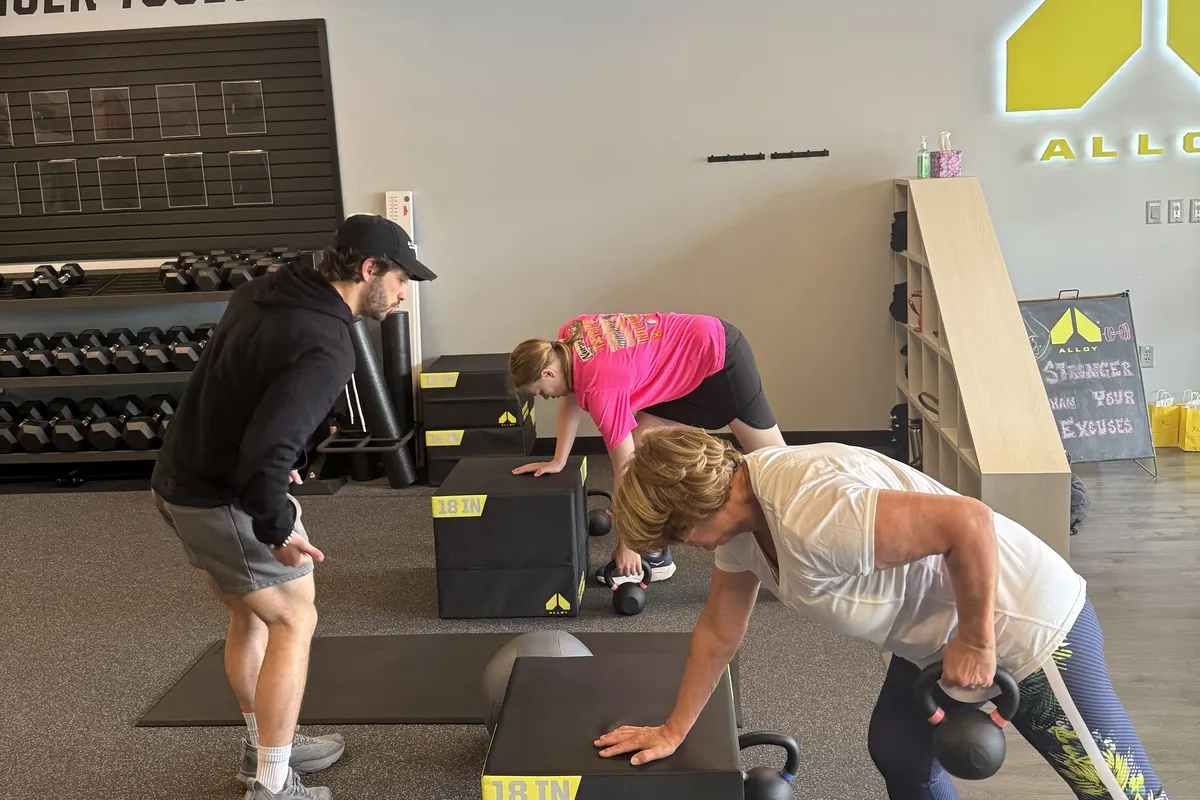
Trail strength comes down to a handful of movement patterns, each scaled to your joints and experience:
- Step-ups and split squats. Every climb is a series of single-leg pushes, so training one leg at a time builds the drive and control hills demand.
- Hinges, like kettlebell or Romanian deadlifts. Strong glutes and hamstrings power you uphill and keep your back from doing your hips' job.
- Goblet squats with a slow lowering phase. On downhills your thighs work as brakes, and controlled lowering prepares your knees for long descents.
- Farmer carries. Walking with weight in each hand trains grip, posture, and trunk stability, the same qualities that keep a daypack from pulling you off balance.
- Calf raises and single-leg balance work. Ankles take the first hit when gravel shifts, and better balance helps you recover a misstep.
Most of it uses free weights and your own body, loaded a little more over time.
Can strength training help keep you on the trail?
The best evidence comes from sports research rather than hiking, but it is strong. A 2014 meta-analysis in the British Journal of Sports Medicine pooled 25 trials with more than 26,000 participants and found that strength training cut sports injuries to roughly a third, and overuse injuries could be almost halved.
Hiking is repetitive and high-volume, which is where overuse problems tend to show up. Stronger muscles and connective tissue handle repetitive load better. That is not a guarantee, and anyone managing a knee, hip, or back issue should check with their doctor or physical therapist before adding trail miles.
How to fit strength work around your hiking
Two strength sessions a week alongside your walking is a practical place to begin for most adults over 40. Schedule the harder leg session a day or two before a long hike, not the evening before.
Progress one variable at a time. In the gym, add load or reps gradually. On the trail, add a longer route, a hillier route, or a light daypack, but not all three in the same week. Our post on whether walking is enough exercise covers why the two work best together.
Daylight saving time ended November 1, pulling sunset to around 5 p.m., so weekday trail walks tend to move to weekends. A personalized exercise program keeps the strength work steady indoors and builds those weekend hikes into the plan.
What should your first step be?
Start by finding out where you stand. The Complimentary Intro Session at Alloy Fairfax City begins with a one-on-one conversation with a coach about your goals, health history, and training experience. If your goal is the full Burke Lake loop, say so.
From there, you get a functional movement assessment to spot mobility restrictions and muscle imbalances, an InBody body composition analysis for a baseline, and an introductory workout scaled to you. No pressure, no obligation.
The studio is on Main St near Old Town Fairfax, and members come from the City of Fairfax and nearby Fairfax Station, Burke, Vienna, Oakton, and Mantua. Book Your Complimentary Intro Session.